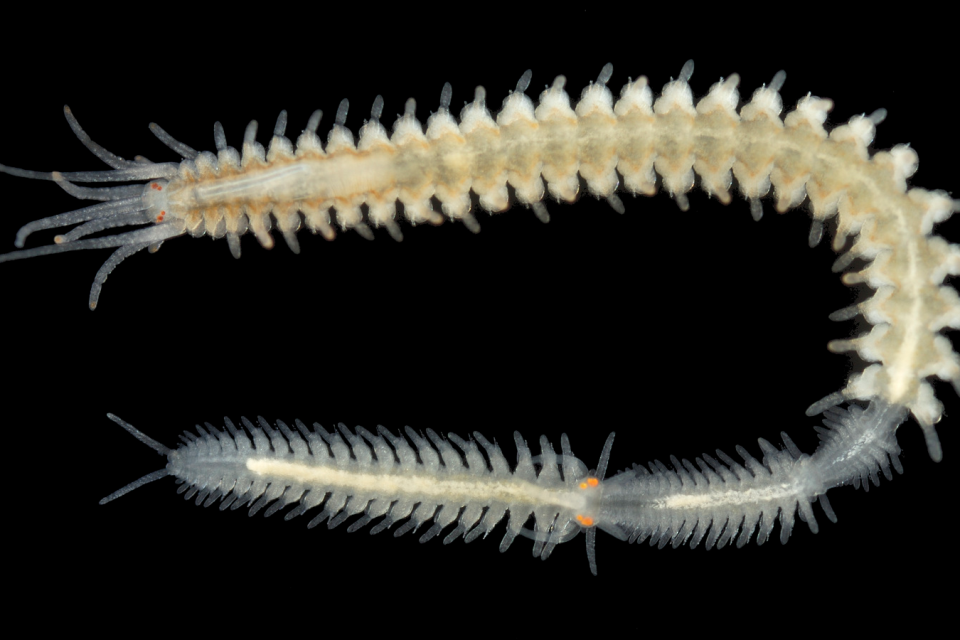
Månedens gruppe – Saccocirridae, de store små

Saccocirridae regnes som en meiofaunal eller interstitiell annelidfamilie, ettersom alle artene finnes i rommet mellom sandkornene. Mens noen få arter kan være ganske små med 3 mm, er flere ganske store med opptil 3 cm i lengde. I tillegg kan de være ganske brede med en kroppsbredde på […]

Group of the month – Saccocirridae, the large small ones

Saccocirridae is considered a meiofaunal or interstitial annelid family as all species are found in the space between the sand grains. While a few species might be quite small with 3 mm, several are quite large with up to 3 cm in length. Additionally, they can be quite […]

Group of the month: Protodriloidae – just two species, but important

Protodriloidae is a family of only two species in the genus Protodriloides. Together, with the families Saccocirridae and Protodrilidae, they are part of the order Protodrilida. We will learn more about the other two families in the next two months. Hence, look forward to it. Both Protodriloides species […]

Månedens gruppe: Protodriloidae – bare to arter, men viktige

Protodriloidae er en familie med bare to arter i slekten Protodriloides. Sammen med familiene Saccocirridae og Protodrilidae er de en del av ordenen Protodrilida. Vi vil lære mer om de to andre familiene i løpet av de neste to månedene. Så gled dere til det. Begge Protodriloides-artene ser […]

Group of the month: Polygordiidae – the shiny knot worms

The next interstitial annelid family, I would like to present to you are the polygordiids. Even though these worms are part of our MeioSkag project investigating meiofaunal species in the Skagerrak, they are not truly meiofauna as their body length ranges from 1-10 cm. Hence, they are quite […]

Månedens gruppe: Polygordiidae – de skinnende knutmark

Den neste interstitielle annelidfamilien jeg vil presentere for dere, er polygordiidene. Selv om disse markene er en del av MeioSkag-prosjektet vårt, som undersøker meiofauna-arter i Skagerrak, er de ikke egentlig meiofauna, da kroppslengden deres varierer fra 1 til 10 cm. De er altså ganske store. Men fordi de […]

Group of the month: The unusual interstitial annelids – Nerillidae

As part of our new ArtsDatabanken project MeioSkag, we are investigating interstitial and meiofaunal species occurring in sediments of the Norwegian part of the Skagerrak. Among others, this includes the so-called interstitial families within Annelida. In this series “Group of the month”, I will now present the different […]

Månedens gruppe: De uvanlige interstitielle leddmarkene – Nerillidae

Som en del av vårt nye ArtsDatabanken-prosjekt MeioSkag undersøker vi interstitielle og meiofauna arter som forekommer i sedimenter i den norske delen av Skagerrak. Dette omfatter blant annet de såkalte interstitielle familiene innenfor Annelida. I denne serien «Månedens gruppe» vil jeg nå presentere de ulike familiene som ikke […]

Group of the month, October: Bats (Order Chiroptera)

As October is best known for the Halloween season, I’d like to dedicate this article to one of the most famous spooky symbols – bats. These creatures are phenomenal on multiple levels. As you may already know, they are the only know flying mammals; they communicate through echolocation […]

Vermetids, the laziest: Snails Who Gave Up Crawling

We all know a worm. We all know a snail. Or at least, we think we do.But nature often blurs the lines we draw so confidently. In the case of vermetid snails, also known as “worm snails,” appearances can be deceiving. These creatures look like worms but are, […]

Group of the month, August: Rough sharks (Genus Oxynotus)

Drawing a shark could be fun, so why not following a step-by-step tutorial for it? As many suggest, let`s start by deconstruct your soon to be shark in simple geometrical figures. A triangle can be the head, a dorsal fin or a tail. One or two rectangles for […]

Månedens gruppe: Begermarker (Kamptozoa eller Entoprocta)

Rekke Entoprocta (også kalt Kamptozoa) er kjent som begermark. Globalt er det kjent 260 arter til dags dato, og 30 i Norge. Individene er små, med en kroppsstørrelse på 0,5–7 mm. Imidlertid bygger andre arter, i tillegg til solitære arter, kolonier som kan bli opptil 25 cm store. […]

Group of the months: The nicking worms (Kamptozoa or Entoprocta)

The phylum Entoprocta (also called Kamptozoa) are known as the nicking worm. Globally, 260 species are known to date and 30 in Norway. The individuals are small with a body size of 0.5 – 7 mm. However, besides solitary species, other species build colonies and these can be […]

Månedens gruppe for juni. Myrfiolene – ei artsgruppe der hybridisering skaper, endrer og fjerner mangfold

Hvorfor er denne gruppa interessant å studere?Myrfiolgruppa (Viola seksjon Plagiostigma, underseksjon Stolonosae; Violaceae) er ei av flere artergrupper i den nordlige tempererte sonen som diversifiserte som respons på global nedkjøling de siste ~5 millioner år. Å studere artene i denne gruppa gir derfor mulighet til å belyse de […]

The marsh violets – a lineage where hybridisation creates, modifies and deletes diversity

Why is this group interesting to study? The marsh violet group (Viola sect. Plagiostigma, subsect. Stolonosae, in part; Violaceae) is one of numerous north-temperate species groups that diversified in response to climate cooling in the last ~5 million years. Thus, studying this group has the potential to elucidate […]

Group of the month, May: The Krill

Featured photo: Euphausia superba, the Antarctic krill. Photo by Professor Dr. habil. Uwe Kils, uploaded to en.wikipedia.org. This file is licensed under the Creative Commons Attribution-Share Alike 3.0 Unported license. https://creativecommons.org/licenses/by-sa/3.0/ Tiny but mighty, krill are among the most abundant animals on Earth and their collective role is […]

Group of the Month April: Family Rhytidocystidae

Cover image: Rhytidocystis polygordiae from the intestines of a polychaete Polygordius sp. (Scale bar = 15 μm) from Leander & Ramey, 2006. https://doi.org/10.1111/j.1550-7408.2006.00109.x For this month’s group, I’m introducing another group of enigmatic protists, the family Rhytidocystidae. They belong to the phylum Apicomplexa, which is known for many […]

Group of the Month March: Laboulbeniales

Let me introduce you to the Group of the Month for March: A fungus! At this point you are probably thinking to yourself: “Wait a minute, that’s not a fungus. That’s clearly just a beetle…” And for the most part, you’d be right! Let’s zoom in a bit […]

Månedens Gruppe Mars: Laboulbeniales

La meg presentere månedens gruppe for mars: En sopp! Nå tenker du sikkert for deg selv: «Vent, det der er ikke en sopp. Det er helt klart bare en bille…» Og det er i og for seg riktig! La oss zoome litt lengre inn: Tankerekken fortsetter: «Hmm… Det […]

Group of the month: Cycliophora – the ringbearers and the “Norwegian” phylum

This month I will present to you a very small phylum of animals – both in size and in number of species. The phylum Cycliophora, which means the ring-bearer, comprises exactly one genus and two described species. These species are about 350 µm in body length, which is […]

Månedens gruppe: Cycliophora – ringbærerne og den «norske» fylumet

Denne måneden vil jeg presentere en svært liten dyregruppe – både i størrelse og i antall arter. Cycliophora, som betyr ringbærer, består av nøyaktig én slekt og to beskrevne arter. Disse artene er ca. 350 µm i kroppslengde, noe som er mindre enn en halv millimeter og omtrent […]

Group of the Month: Tree ferns – an Australian holiday discovery

A visit to the Adelaide Botanic Garden is certainly high up on the to-do list of a biologist visiting the capital of South Australia. In December 2024, a couple of days before the Australian midsummer, I had the pleasure to visit the Adelaide Botanic Garden and explored the […]

Christmas in the Ocean: The Marvel of Christmas Tree Worms

Today, I want to introduce a fascinating group of worms that are particularly relevant during the Christmas season. Known as Christmas tree worms, these marine annelids belong to the family Serpulidae. They are renowned for their radiolar crowns and their habit of dwelling within calcareous tubes attached on […]

Group of the month November: Metchnikovellidae

Cover image: Metchnikovella incurvata, a parasite of a bristle worm infecting gregarine. Picture from Galindo et al. 2018, https://doi.org/10.1093/gbe/evy205 For this month’s group, I want to present you another group of organisms I am currently working with in my postdoc project PolyPro3 here at NHM Oslo. This is […]

Group of the month September– Viola

This month I wish to present a group that I have been working on for nearly 30 years, the angiosperm genus Viola which comprises violets and pansies (Figure 1). Our group recently produced a monograph of the genus (Marcussen et al. 2022) – the first comprehensive (and very […]